The quadrants aren’t just for trianing
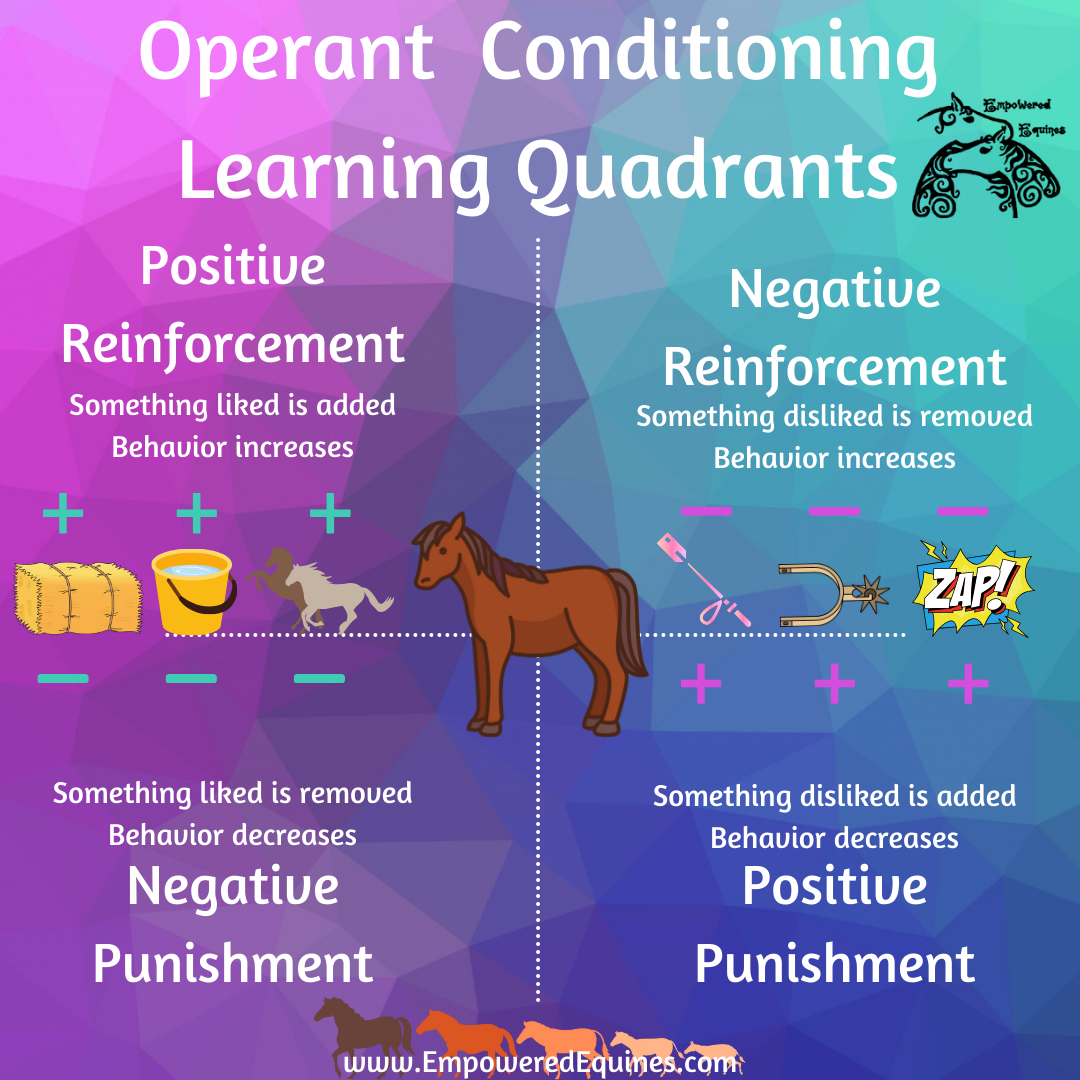
The quadrants are a natural function, like Gravity. We aren't using gravity as a tool to hold us to the planet and we can't stop using gravity so we can float away Gravity is there, as a law of nature, in the background all the time. The quadrants are there, happening in the background all the time, as interpreted by the being who is learning to operate their environment (operant conditioning). Whether the horse is learning how to reach under their fence for the good grass or whether they're learning to bow for a click and treat. The quadrants are happening. We can utilize our knowledge of gravity and physics to move ourselves around without falling most of the time but we aren't "using" gravity as a tool to control the world around us. We're simply using our understanding of how gravity works to educate our choices. So, we can use our understanding of the quadrants to better educate how we train our horses, but the quadrants are present and active, as interpreted by the learner, no matter what we do.
WE Do NOT Use the Learning Quadrants! We aren't using these as tools, they are not tools, they are not something we can even really control. People often think R+ trainers are using the quadrants as a tool to modify behaviors, as a means of control. There are certainly some trainers who train in a controlling/manipulative way, but that's not the fault of the quadrants.
The quadrants are a description of how the learner learned through the consequence of their behavior. It doesn't come BEFORE the behavior, it comes as a description of what happened. The horse feels something, internally or externally, they respond based on their genetic coding, their learning history, their personality, etc.. Then the behavior they chose either works or doesn't work, which causes them to choose that behavior more or less in the future. This is a super brief overview of what happens when a learner learns something about their behavior.
If the learner appreciates the outcome, the behavior will likely happen more in the future, this means the behavior was reinforced. It was reinforced either because something they like was ADDED (positive) or something they dislike was removed (negative). This is a description of what happened in the learning experience as determined by the learner - not the trainer! If the behavior decreases in the future, it means the behavior wasn't helpful for them in that scenario, it didn't work. So, the behavior was punished, either because something disliked was added or something liked was removed.
This is a super basic overview of what's happening in the background of all the emotions, feelings, past learning, all the mumbo jumbo around everything that happened around the behavior. The quadrants are just the simplest, most underneath, description of how learning took place.
If learning happened a quadrant took place. If a behavior increased or decreased in frequency, a quadrant was involved. Because it's just a description of how the behavior was modified. Whether it was contrived by a human or just a natural situation.
When bugs are climbing on a horse's leg the horse finds this unpleasant (we know this because it motivates a behavior) the behavior usually is stomping a foot, this usually causes the bugs to fly away (at least for a brief moment) which negatively reinforced the behavior of stomping their feet when something tickles their legs. The bugs aren't training the horses, the horses aren't training the bugs, but a behavior was learned.
We can, however, take our understanding of this knowledge and use it to influence our horse's behaviors in our own interest. But this can be done in anyway. Traditionally horse training was done with R- and P+ in a variety of different ways. Now intentionally using R+ is becoming more common. But which quadrant we're trying to use and which we actually used is determined by the learner, not us. And which quadrant we're trying to use does not determine whether our training or what we're training is different for everyone. You can train coercively or thoughtfully, caring and gentle or forceful and competitive with any combination of techniques. These are just an underlying description of how learning happened. How we try to use them and what we try to use them FOR is independent of that.